
October’s Birthstone: The Healing Powers and Hidden Meanings of Opal

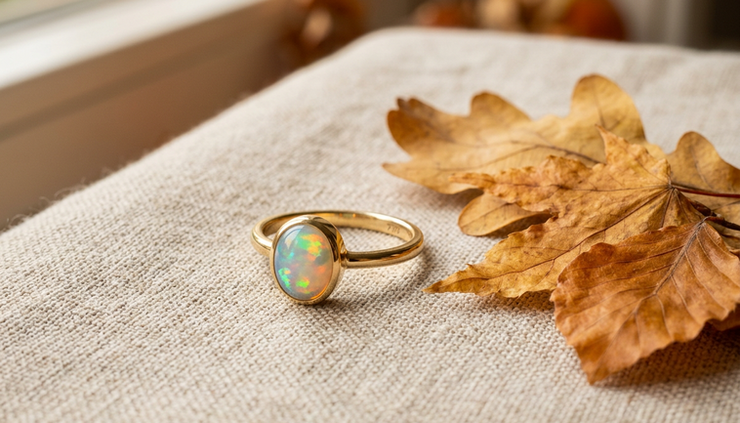
Opal looks less like a single stone and more like weather captured in mineral form. One turn of the wrist can reveal blue sparks, green flashes, orange fire, or a milky glow that seems to come from within. That shifting color is why opal has long been tied to imagination, emotion, mystery, and personal transformation.
For October, opal carries a meaning that fits the season beautifully. It reflects change, depth, and hidden brilliance. As leaves turn and light softens, opal feels right at home: luminous, unpredictable, and full of character.
This guide explores the meaning of the opal birthstone, the healing powers often associated with it, the legends that surround it, the main types of opal, and the best ways to care for this unusually delicate gem.

Why opal is the birthstone for October
Opal has been associated with October for generations, partly because of its autumn-like range of color. It can hold the pale glow of mist, the red-orange heat of falling leaves, and the electric blue of a cold, clear sky. Few stones feel as changeable or as seasonal.
October has two modern birthstones, opal and tourmaline, but opal remains the more traditional choice. Its appeal comes from its play-of-color, the optical effect that creates shifting rainbow flashes inside the stone. Not every opal displays this effect, but when it does, it can look alive.
Scientifically, opal is a form of hydrated silica. Unlike crystals such as quartz, opal is amorphous, meaning it does not have a regular crystal structure. Within precious opal, tiny silica spheres are arranged in a way that bends and scatters light. That structure creates the flashes of color collectors and jewelry lovers value so highly.
Symbolically, this makes opal a fitting stone for people born in October. It suggests complexity, emotion, creativity, and the ability to show different sides of oneself in different light.
Among gems, birthstones, and symbolic jewelry, opal stands apart because its beauty is based on movement. It rewards attention. The longer you look, the more it reveals.
The meaning and symbolism of opal
Opal has gathered meanings from many cultures and historical moments. Ancient writers admired it because it seemed to contain the colors of many gemstones at once. Some compared it to ruby, emerald, sapphire, and amethyst combined in one stone.
Across time, opal has been linked with:
Hope
Emotional clarity
Creativity
Intuition
Protection
Love and loyalty
Transformation
The stone’s shifting colors make it easy to see why people connect it with imagination. It does not present one fixed appearance. It changes with light, angle, setting, and background.
That visual quality has shaped much of its symbolism. Opal often represents inner life, especially feelings that are not always easy to express. It is a favorite stone for artists, writers, and anyone drawn to beauty with a little strangeness around the edges.
Opal and emotional depth
Opal is often described as a mirror stone. In metaphysical traditions, it is believed to reflect emotions and bring hidden feelings closer to the surface. For that reason, some people wear opal when they are moving through personal change, grief, renewal, or creative growth.
This does not mean opal has medical or psychological effects. Its “healing powers” belong to spiritual, symbolic, and traditional belief systems. Still, many people find meaning in using gemstones as reminders, meditation tools, or personal symbols.
A person who wears opal might see it as a cue to slow down, pay attention, and trust intuition. In that sense, its value is both beautiful and personal.
The healing powers associated with opal
The healing traditions around opal are rich, but they should be understood as complementary and symbolic rather than medical. Opal should never replace care from a qualified health professional. Its power lies in meaning, ritual, and emotional connection.
In crystal healing traditions, opal is often associated with the following qualities.
Emotional balance
Opal is said to help bring feelings into awareness. For people who use gemstones in meditation, it may serve as a symbol of emotional honesty. Its changing colors can remind the wearer that moods shift, feelings evolve, and no emotional state is permanent.
Creativity and inspiration
Because opal appears to contain many colors at once, it is often connected with artistic energy. Writers, musicians, designers, and makers may be drawn to it as a symbol of original thought.
A simple practice is to keep opal nearby while journaling, sketching, or planning a creative project. The stone becomes a visual prompt to explore new ideas without forcing them.
Intuition and inner wisdom
Opal’s glow has long been tied to intuition. Some traditions link it to dreams, visions, and the ability to sense subtle truths. Whether or not one holds those beliefs literally, opal has a quiet, reflective beauty that can support mindfulness.
Love and passion
Certain opals, especially fire opals, are linked with warmth, desire, confidence, and emotional energy. Softer white opals may be associated with tenderness and calm. Pink and pastel-toned opals often carry meanings of compassion and gentle affection.
The mystique and legends surrounding opal
Opal’s reputation has not always been simple. At different times, people saw it as lucky, protective, magical, mysterious, or even unlucky. That mixed history adds to its fascination.
In ancient Rome, opal was highly prized and associated with hope and purity. Because it showed many colors, it was seen as a treasure with the virtues of several stones combined. In some traditions, opal was believed to sharpen eyesight or protect the wearer from harm.
During later periods, superstition gave opal a darker reputation. Some people came to believe it brought bad luck if worn by someone who was not born in October. Much of that fear likely grew from fiction, rumor, and the fact that opal can crack if poorly cared for. A fragile stone can easily become wrapped in stories.
Today, most jewelry lovers see those old warnings as part of opal’s mystique rather than a reason to avoid it. The stone’s reputation has returned to one of beauty, sensitivity, transformation, and personal meaning.
The most compelling myth around opal is not that it is lucky or unlucky. It is that the stone seems impossible to fully know. Two opals from the same region can look completely different. One may glow like moonlight. Another may flash with green lightning. Another may burn orange from the inside.
That unpredictability is the heart of opal’s charm.
The main types of opal and how they differ
Opal comes in many forms, and each has its own personality. Some types are valued for strong color flashes. Others are loved for body color, transparency, pattern, or rarity.
Type of opal | Main appearance | What makes it special |
White opal | Pale body color with soft rainbow flashes | Classic, luminous, and widely recognized |
Black opal | Dark body color with intense play-of-color | Highly prized because colors appear dramatic against the dark base |
Fire opal | Yellow, orange, or red body color | Known for warm color, with or without play-of-color |
Boulder opal | Opal attached to ironstone matrix | Natural, earthy, and often patterned |
Crystal opal | Transparent to semi-transparent body | Color appears suspended inside the gem |
Common opal | Usually no play-of-color | Loved for smooth color, glow, and affordability |
White opal has a soft and classic glow
White opal is one of the best-known varieties. It usually has a white, cream, or pale body color with flashes of green, blue, yellow, orange, or pink. Its beauty tends to feel gentle rather than dramatic.
This type works well in vintage-style rings, pendants, and earrings. It pairs beautifully with yellow gold, rose gold, and silver. Because of its soft look, white opal often carries meanings of calm, hope, and emotional renewal.
Black opal shows the strongest contrast
Black opal has a dark gray, blue, green, or black body tone. That darker base makes its play-of-color look more intense. Blue, green, red, and violet flashes can appear electric against the dark background.
Fine black opal is among the most sought-after opal varieties. It is often used in statement rings and collector pieces. Symbolically, it feels protective, powerful, and mysterious.
Fire opal brings warmth and energy
Fire opal is known for its body color rather than only its color play. It ranges from golden yellow to vivid orange and red. Some fire opals are transparent or translucent, and some show flashes of green or other colors.
This variety often comes from Mexico, though fire-colored opals can occur in other locations. Fire opal is associated with passion, courage, energy, and confidence. It has a very different mood from white opal, brighter, bolder, and warmer.
Boulder opal keeps part of the earth with it
Boulder opal forms within ironstone and is often cut with that host rock still attached. The result can be striking: bright opal seams running through dark brown matrix.
This type has a natural, grounded look. No two pieces are alike. Boulder opal is ideal for people who like gemstones that feel organic rather than polished to complete perfection.
Crystal opal has a luminous inner depth
Crystal opal is transparent to semi-transparent, so light can enter and move through the stone. Its flashes can appear to float inside the gem rather than sit on the surface.
This type can be especially mesmerizing in pendants and earrings, where light passes through it. Crystal opal often carries meanings of clarity, insight, and spiritual openness.

How to care for opal jewelry
Opal is beautiful, but it is not the toughest gemstone. On the Mohs hardness scale, opal usually falls around 5.5 to 6.5. That means it is softer than sapphire, ruby, diamond, and quartz. It can scratch, chip, or crack if handled roughly.
Opal also contains water in its structure. Sudden heat, very dry conditions, and harsh cleaning methods can damage it. With good care, though, opal jewelry can last for many years.
Clean opal gently
Use a soft, damp cloth and mild soap when needed. Wipe the stone carefully, then dry it with a clean, lint-free cloth.
Avoid:
Ultrasonic cleaners
Steam cleaners
Harsh chemicals
Bleach or ammonia
Abrasive jewelry cloths
Stiff brushes
Doublets and triplets need extra care. These are layered opals made with thin slices of opal attached to backing materials or protective caps. Soaking them can weaken the adhesive, so clean them with a lightly damp cloth instead of immersing them in water.
Protect opal from impact
Opal rings are especially vulnerable because hands knock against hard surfaces throughout the day. If wearing an opal ring, remove it before gardening, cleaning, exercising, cooking, or lifting heavy items.
Pendants and earrings tend to be safer choices for everyday wear because they face less impact.
Store opal the right way
Keep opal separate from harder gemstones. Diamonds, sapphires, and rubies can scratch it if they touch in a jewelry box.
Good storage habits include:
Place opal in a soft pouch or lined jewelry box.
Keep it away from direct sunlight and heat sources.
Avoid very dry storage spots for long periods.
Do not leave it in a hot car or near a heater.
For valuable opals, a jeweler can check settings and condition during regular jewelry inspections.
Wear opal with awareness
Opal is best treated as a “last on, first off” gemstone. Put it on after lotions, perfumes, hairspray, and makeup. Take it off before washing dishes, bathing, swimming, or using household cleaners.
This simple habit protects both the stone and the setting.
How to choose the right opal
Choosing opal is personal because each stone has such a distinct character. Instead of looking for one “best” type, focus on the qualities that matter most to the wearer.
Look at these features:
Color play
Strong flashes of color often increase appeal and value. Red flashes are typically rarer than green or blue, though beauty always comes down to the whole stone.
Body tone
A dark body tone can make colors look more dramatic. A pale body tone creates a softer, more romantic effect.
Pattern
Some opals show pinfire specks. Others show broad flashes, rolling color, or mosaic-like patches. Pattern affects personality as much as value.
Transparency
Transparent and semi-transparent opals can feel airy and glowing. Opaque opals often look rich and solid.
Setting style
A protective setting matters, especially for rings. Bezel settings can guard the edges better than high prong settings.
Personal meaning
For October gifts, choose the stone that matches the person’s style. White opal feels classic. Black opal feels bold. Fire opal feels warm and expressive. Boulder opal feels earthy and distinctive.

Why opal remains one of the most captivating October stones
Opal does not offer the predictable sparkle of a diamond or the saturated color of a sapphire. Its beauty is stranger and more changeable. That is exactly why people love it.
It carries the feeling of something hidden becoming visible. It can look quiet one moment and brilliant the next. It connects naturally with October, a month of shifting light, seasonal change, and reflection.
Its healing meaning centers on emotion, imagination, intuition, and renewal. Its mystique comes from centuries of admiration, superstition, and wonder. Its many varieties let each person find a version that feels personal, whether that means the soft glow of white opal, the drama of black opal, or the warmth of fire opal.
Treat opal with care, and it will reward that attention. Keep it away from hard knocks, harsh cleaners, heat, and careless storage. Choose a stone that speaks through color, pattern, and feeling.
The best opal is not only the rarest or the most expensive. It is the one that keeps changing every time the light finds it.


Comments